


Edition #41 of Implications.
This edition explores forecasts and implications around: (1) the growing premium of originality, (2) future metrics and optimizing “revenue per employee,” (3) the promise and perils of citizen-driven apps for surveillance, and (4) a market outlook and other observations/surprises at the end, as always.
If you’re new, here’s the rundown on what to expect. This ~monthly analysis is written for founders + investors I work with, colleagues, and a select group of subscribers. I aim for quality, density, and provocation vs. frequency and trendiness. We don’t cover news; we explore the implications of what’s happening. My goal is to ignite discussion, socialize edges that may someday become the center, and help all of us connect dots.
If you missed the big annual analysis or more recent editions of Implications, check out recent analysis and archives here. A few recommendations based on reader engagement:
What are we gonna do? This outlook on the human opportunities in the era of “superhumanity” ahead continues to stimulate conversation in my life.
As I reflect on years of advising founders and building digital consumer products, I am struck by one consistent theme across the most deeply engaging and retentive products: they provide ways to help people flex something. What are the forms of flex in consumer products, in the age of AI?
On the return of apprenticeships: We need to swarm ourselves and our teams with those native to new platforms in order to know how to use them (happened with social media in the early 2000’s, and is happening again now with AI). Perhaps the apprenticeship model was one of the greatest casualties of the industrial revolution – and is overdue for a comeback.
The Growing Premium of Originality

It has been a bit sad to see influencers using AI to quickly recreate iconic scenes and rip iconic IP and styles, and then exclaim how “easy” it was — and how this will destroy Hollywood as we know it.
Of course, mimicry is nothing new. Most of the world has always attempted to emulate.
Remaking a masterpiece isn’t hard.
Making a masterpiece is hard.
We have entered an era in which copyright law will become more important as new technology enables infinite riffs and rips. There will be unauthorized sequels that wholesale rip IP and trade on the dark web, and many copycat shots. As always, no past masterpiece is sacred or protected as it becomes increasingly easy to reference or reproduce anything. What does this mean for the demand side of entertainment? As our feeds become filled with pirated IP violations and copycat scenes, what will we crave more of?
Originality is the primary ingredient of timeless creations. Catchy pop songs that spread fast through their instant familiarity may become earworms but never become timeless. Sequels have built-in audiences, but tend to be more of the same. But now think about mainstream timeless art, from Van Gogh’s The Starry Night to Michael Jackson “Thriller,” “The Nutcracker” and “Sgt. Pepper’s Lonely Hearts Club Band,” to “Ferris Bueller’s Day Off.” These iconic wildly different pieces of IP became timeless through their sheer originality. As it becomes easier to make replays and copycats and the market floods, culture will favor originality more than ever before. Perhaps this will manifest itself through our growing hunger for weirdness, a growing tolerance for ambiguity and uncertainty when hearing or watching something entirely unfamiliar, and a growing “cultural flex” for being the person that discovers something new or lesser known?
Originality and quality will carry a premium: As the “low hanging fruit” of any aspiring creator becomes pre-existing IP and the styles and ideas of others, truly original IP and creative decisions will carry a greater premium than ever before. Why? Because we’ll be overwhelmed with copycat slop. Familiar characters and copycat directorial styles and scenes will fill our feeds. We may find some of it entertaining, but we’ll also recognize it for what it is. People are becoming much better at knowing when something wasn’t made by people. Just as the ubiquity of fast food didn’t threaten the business of fine cuisine (and arguably further distinguished it), consumers will crave MORE original high-quality storytelling. And much like Michelin stars and famous chefs curate and help us distinguish quality, modern media and entertainment brands will play a similar role. The age-old challenge with originality is discovery. New IP must somehow break through the algorithms and escape the noise to find its audience — all while remaining economically viable. New AI-powered tools hurt or help, depending on how they are used. They can be abused to rip IP/styles and create exponentially more “unoriginal” content, or they can be used tactically to help craft entirely original stories that wouldn’t have otherwise had a chance of getting made and finding their audience. My bet is that, even as digital chisels evolve to include AI features, the most successful original and high-quality creations will continue to be human-crafted, infused with meaning from human emotion. As consumers get tired of recycled IP and slop, demand for such human-crafted originality will go up. As for the true artists, they’ll love the growing consumer demand for originality. My friend and long-time editor Ed shared the story of a Joni Mitchell live album where you can hear the audience calling for her to play their favorite song and she responds, “Nobody ever said to Van Gogh, ‘Paint a Starry Night again, man!’”
We will crave originality in our pursuit of taste. In the January edition of IMPLICATIONS, we explored the era of SUPERHUMANITY ahead of us, and the essential attributes that will help humans become more important rather than less. The development of taste, via inputs, is a key part of this pursuit. Much like our pursuit of health requires a nutritious diet with less fast food, the pursuit of taste will require consumption of original ideas and stories. I anticipate more time and energy spent on curation and culturally enriching consumption over the years ahead. I anticipate new consumer products that deliver carefully curated, original items of culture that offer a sharp contrast amidst a sea of sameness. Our identity formation will increasingly favor consumption of original inputs, in the form of unique experiences, wildly original and unfamilar (aka “weird”) content, and eccentricity in our social circles.
We will look for origin stories and flaws as evidence of authenticity. If art ultimately gains value through its story and provenance, then any digital or physical artifact is best presented alongside the story of how it was made. We’ve discussed in previous editions how iconic advertising from brands like Apple is increasingly accompanied by behind-the-scenes footage. The reason, of course, is fortification of the brand message via the stories and the artifacts of humanity behind the story. As we seek originality, we will look for humanity. And one telltale sign of humanity is our flaws. We should expect to see deliberate artifacts of humanity in the art, films, and stories we consume as a subtle flex of the people and struggle behind the work.
Revenue per employee: The future metric?
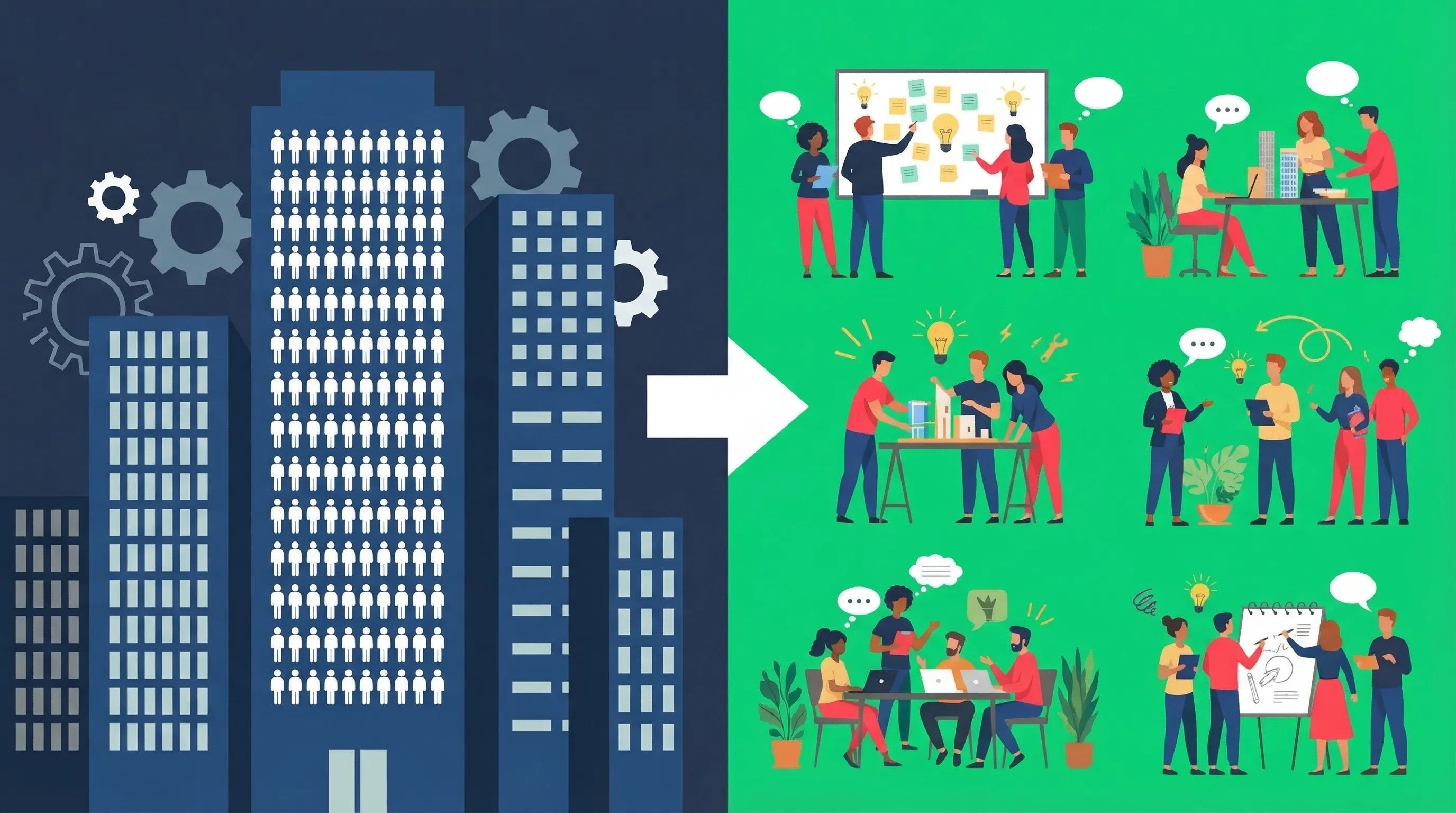
We are amidst the big employment shift that we have long anticipated. I have always believed that new types of jobs will emerge as consumer and enterprise demand shifts to new types of products and services (for instance, customer service may be performed by AI, but humans will also crave more hospitality and offline experiences in response). But it will take some time for labor supply and demand to settle. In the long term, I think there will be 100x more companies, but each company will be much smaller. However, in the journey towards equilibrium, there will be a lot of volatility and some periods of despondence. In the last week of February, we saw Block announce a 40 percent reduction in its workforce. In response, their stock went up ~20 percent. Why? There is clearly a consensus view that companies can be smaller, operate with higher margins, and be more effective by refactoring themselves.
Right now, we’re entering a phase during which large companies staffed with “knowledge workers” will undergo a blunt refactoring as most knowledge work (perhaps up to 80 percent?) is offloaded to compute. These organizations will emerge from this volatile period as smaller, more dense with talent, and less hierarchical. The employees that remain will be those that own a metric they can directly impact, often leveraging AI in profound ways. Each remaining worker will be a stakeholder in more things, but without the bureaucratic costs of a highly-matrixed organization. After the dust settles from this stomach-churning transition, the workforce will feel more empowered. What are the future measures for refactored organizations? And what are some of the implications of this great refactoring before us?
This size of one’s organization is still a flex, just flipped. Leaders’ influence in a company – and a public company CEO’s ego – has long been determined by the size of the workforce they oversee. But we’re moving from the time when you bragged about how big your company or division was to bragging about how small it is. The new measure of ingenuity and strategic leadership is resourcefulness, as measured by building a large business with as few people as possible. There is a chapter in my book THE MESSY MIDDLE about how “resourcefulness outperforms resources,” but I never anticipated just how true this would be in the era of AI.
As we focus more on “revenue per employee,” companies will make MORE products and services. As each employee becomes more resourceful and capable, augmented by an unlimited number of agents they can unleash to perform whatever knowledge work (any idea that requires routine work) they can think of, the revenue per employee will go up. A funny thing happens when the ROI (return on investment) of a person goes up: we start deploying MORE people — BUT only in ways that sustain or increase the ROI. Rather than larger organizations within a company, you’ll have MORE smaller organizations. My bet is that companies will deploy more people NOT to scale their existing products and services, but rather to launch new products and services. Brands will leverage their existing customer bases and go-to-market advantages as they roll out ancillary products and services and become ecosystems (rather than single product companies) in unexpected ways. Meanwhile, as large companies offer broader collections of products, more startups will emerge that compete with greater simplicity and focus. It’s the great bundling/unbundling Silicon Valley life cycle all over again!
Less interdependency, more owning metrics end-to-end: In the era of agents, everyone must be able to own and directly impact a metric that matters. If you’re not one of the few leaders tasked with planting the flag for where a product or company is going, the key question is what outcome are you personally driving for the company every day? Until now, companies have been chains of people trying to survive the game of operator, pointing fingers at dependencies in the chain of work, and relying on countless middle managers and processes to stay coordinated and drive alignment. I truly believe that modern, AI-based development irons out these inefficiencies and unleashes a new era of direct ownership, impact, and accountability. Once you have agentic capabilities across every function, it is far easier to have every employee own metrics they can directly impact and achieve on their own.
Does IT become the most important team? In this world we are describing, I suspect the fastest growing teams within every company will be the teams that deploy and monitor agentic tools within companies, oversee permissions and security, and build the tailor-made software for the organization that replaces the clunky general-purpose tools that defined previous decades of productivity. Today, these centralized teams simply don’t exist and/or, like the classic IT function, aren’t sufficiently empowered in large companies. But I have witnessed firsthand that companies able to take a “first principles” approach to their operations in the AI era are able to do things very differently.
Talent density & the bar for incremental hires: If every hire makes “revenue per employee” either go up or down, how does that factor into headcount planning? Will we seek to hire more-entrepreneurial people who will come up with new products and services within the company? Will modern forms of compensation provide incentives for brazen agency, rewarding those who realize that they can just DO THINGS and own the outcome — from idea through execution?
The next few years of refactoring will be significant. Business models will shift to capture value in new ways as “seats” becomes a less significant measure of usage. Companies will shrink in size but grow in number – and grow in ambition. As the ROI from each team member goes up, we will refactor organizations to unlock more of what each of us is uniquely capable of. I am bracing for the volatility while being hopeful for the new era of work — and superhumanity — ahead of us.
Citizen-driven applications for surveillance & analysis
Just a couple years ago, a custom piece of software that integrates tons of publicly available data— from the location of military aircraft, citizen reports of explosions, notable shifts in prediction markets, pizza order spikes in Washington DC, and news from every possible source — into one centralized dashboard with a layer of analysis on top would likely have only existed within the CIA or some other governmental agency. Historically, this is called OSINT (open-source intelligence) and exploiting it once required a team of analysts and government-level resources. Now it just requires a motivated developer working over a weekend….and this genie doesn’t go back in the bottle. In fact, this sort of application is in the sweet spot of what AI software development is capable of today.
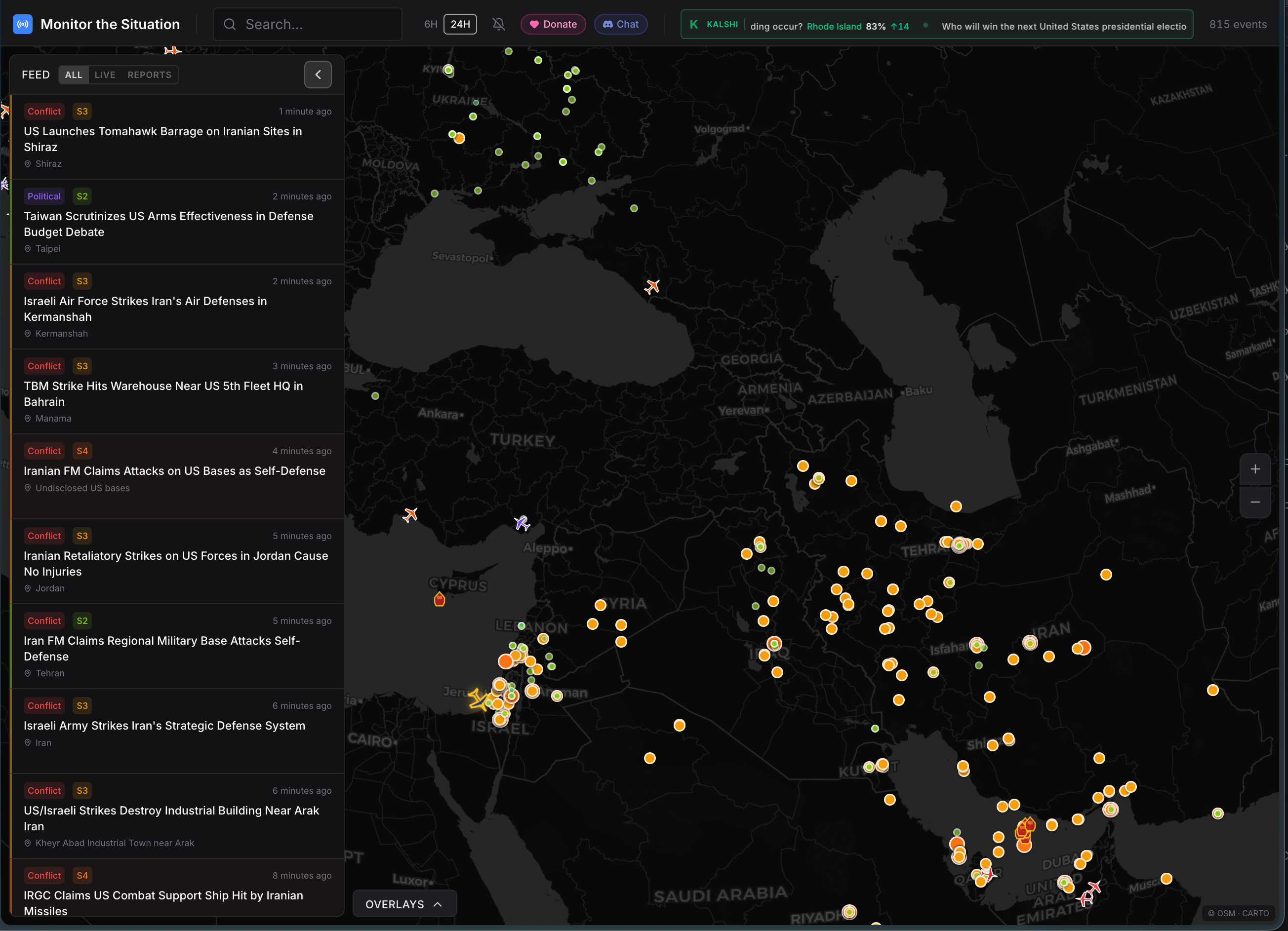
As the Iran strikes began at the end of February, I was struck by just how many “citizen-driven applications” for surveillance and analysis emerged — and how many journalists I know seemed to reference and rely on these tools, like the one screenshotted above. As AI outfits anyone with curiosity and initiative to build their own applications with access to every imaginable public source of data, citizen-driven analysis has suddenly become a top resource for journalists and the general public. These tools certainly provide more real-time transparency to citizens than the soundbites from any government spokesperson. As data sources expand and the ability to build and access these tools grows, there are several implications worth considering.
The use of strategic data noise to skew the consensus: As citizen-driven applications become ubiquitous and serve as sources of “truth” for the general population as well as our adversaries, we can expect that governments may manipulate the data sources. Already, according to a report from X, we saw a large spike in Iran-operated bots with all sorts of skewed reports and commentary as the strikes began. All of these messages are, of course, a data source that citizen-driven applications may be influenced by. But I suspect data from flight radars and other sources are also at risk of being manipulated for strategic reasons.
Fog of war issues: In fast-moving situations, these new tools can rapidly amplify false reports and shift the public narrative – including the hot takes by journalists and governments themselves. That can lead to false confidence when pattern-matching is applied to information that turns out to be noise. The pizza-order-spike heuristic is charming until it’s wrong at a critical moment.
Designer and developer accountability: While a software contractor or government spokesperson who misleads the public can face consequences — congressional hearings, FOIA requests, and career damage — the makers of citizen-driven applications have no standards to meet. There is no efficient and centralized correction mechanism beyond community-driven criticism and a developer’s own conscience.
Clandestine physical operations become more critical: As citizen-driven surveillance and analysis becomes more powerful, everything that happens without leaving any residual data in its wake may become a larger differentiator. As information about battleship deployments and fighter jet placements become easier to find, a new era of clandestine operations is likely to emerge. We have no idea what this might look like, but that’s probably a good thing!
Ideas, Missives & Mentions
Finally, here’s a set of ideas and worthwhile mentions (and stuff I want to keep out of web-scraper reach) intended for those I work with (free for founders in my portfolio, and colleagues…ping me!) and a smaller group of subscribers. We’ll cover a few things that caught my eye and have stayed on my mind as an investor, technologist, and product leader (including my take on the whole “what’s gonna happen in the markets because of AI” take as a “push, push, punch” scenario, Chinese IP issues, and a few data provocations). Subscriptions go toward organizations I support including COOP Careers and the Museum of Modern Art. Thanks again for following along, and to those who have reached out with ideas and feedback.
