


Edition #38 of Implications.
This edition explores forecasts and implications around: (1) our daily work and life becoming summarized, (2) products that succeed and fail with the need for flex, (3) anticipating AR, and (4) some surprises (and a preview of my 2026 predictions) at my at the end, as always.
If you’re new, here’s the rundown on what to expect. This ~monthly analysis is written for founders + investors I work with, colleagues, and a select group of subscribers. I aim for quality, density, and provocation vs. frequency and trendiness. We don’t cover news; we explore the implications of what’s happening. My goal is to ignite discussion, socialize edges that may someday become the center, and help all of us connect dots.
If you missed the big annual analysis or more recent editions of Implications, check out recent analysis and archives here. A few recommendations based on reader engagement:
There are two types of people making stuff: content creators and artists. There is one distinct difference: Content creators are willing to trade control for speed. Artists are not. This edition on AI & Artistry generated a strong response (agreement and disagreement).
We need to value nuance more than ever before. We’re getting more tribal these days and, as a consequence, losing our search and appreciation for nuance. To make matters worse, technology is making it harder to access nuance. The business models of journalism simply do not support nuanced reporting. The primitive part of our brains fears it. And the algorithms altogether hide it. As a result, tribalism further divides us.
Why new social or media apps with entirely generated content (content made solely from prompts) are likely to fail, and why creator technology is only enticing if it unlocks creative risk-taking and human storytelling.
We’re entering the Era of Summarized Living, when every interaction becomes part of a permanent and hyper-intelligent memory

A friend at a top AI research lab was recently walking me through her daily routine using a product called Plaud. This device listens to your conversations and has software that automatically summarizes your discussions every day, develops mind maps of the topics, captures anything actionable, and allows you to have a live AI-enabled discussion with your memory (everything Plaud has ever recorded – increasingly stored locally (aka private). There are similar products in the market like Limitless (just acquired by Meta), software-only solutions like Granola and features from companies like Atlassian and Notion that do this for meetings. Many believe that OpenAI is building a similar device as well.
It is important to note that the next generation of these products will be increasingly intelligent and seldom just record and store everything. Instead, they will summarize and analyze our conversations and create a memory that is private, respects the privacy of others we meet, and isn’t a word-for-word transcript, but rather serves as an extension of your brain. Slowly but surely, we’re entering a world where every discussion and interaction we have will be part of a permanent intelligent memory that is always accessible and unlocks all kinds of insights and connections. As this future approaches, what are some of the less expected implications?
The Era of Summarized Living will remove bias from work and life. One striking lesson I learned while serving on a jury almost twenty years ago was just how bad and biased our memories are, even when our only job is to remember something. In my jury experience, the group routinely recalled a situation or something a witness said one way, only to be corrected by the court recorder with the actual transcript. Can you imagine how many experiences in daily life – from employment interviews and performance reviews to team meetings and spousal debates (uh oh) – are riddled with biased and bad recollections? Perhaps relying on our natural memory will someday become unthinkable, much like navigating the world in the era before anything was written down. Obviously, the prospect of having everything you say recorded can stir some dystopian anxieties, but let’s look at the bright side. Once everything is summarized and analyzed, we’ll start living more by fact than conjecture. There will be more accountability and meritocracy as the summary of what we planned and what we actually accomplished becomes irrefutable and unobstructed by organizational politics and sound bites. And comparing what we remember to a true factual record of what actually happened will help us recognize our own biases and destructive tendencies.
The end of anything verbatim. What if summarized living is better than saving actual records of everything? As the world becomes more litigious and politically polarized, most companies have launched document retention policies that essentially auto-delete emails, Slack messages, and other forms of communication after a certain period of time. Some of my CEO friends barely even send email anymore, knowing that everything they do could someday be retrieved and taken out of context. The interesting thing about AI-enabled summarization technology is that it is just that, a summary. There is no need for attributable quotes, there is always a layer of interpretation. I imagine such summaries will cut both ways - protecting the innocent by preventing misconstrued statements and certain words in litigation while hurting those with ill intention.
We will start to converse differently, for the sake of better summarization. I recall the moment that the annual TED conferences became more about the videos shared afterward and less about the experience for the live audience. TED speakers would literally stop and say a sentence again just to get a better cut in the post-production edit. Similarly, as our daily conversations become summarized for future use, we will start adding trigger words for the purposes of better search and post-meeting analysis. We will be more careful about attribution, likely saying “someone told me,” rather than always mentioning a source by name. And perhaps we will become far more team-oriented and grounded in facts, given the ability for an AI-enabled post-game analysis after every meeting.
Me becomes we: We’ve previously discussed in IMPLICATIONS what might happen when our personal memory at work, enabled by this technology, becomes shared and accessible by our colleagues. Should we be able to search each others’ memories like we do shared documents? If not, what is the new etiquette for accessing a colleague’s summarized work life? What happens to your memory when you leave a company – do they get to keep it? As we enter the Era of Summarized Living, there will be all sorts of ethical and cultural questions around who we share our summaries with, what we allow our spouses and co-workers to access, and how we balance the inefficiencies of our private minds with the superpowers of our collective minds. In the spirit of science fiction being a prototype (or a warning) for the future, the new series “Pluribus” explores the concept of a shared mind and one of the original “Black Mirror” episodes explores the implications of infinitely retrievable memory. Interesting days ahead.
What AI-enabled social and consumer products are missing: Flex
As I reflect on years of advising founders and building digital consumer products, I am struck by one consistent theme across the most deeply engaging and retentive products: they provide ways to help people flex something that they take pride in. No matter what product you are building, it is important to consider the “ego analytics” of your product, as well as which type of flex best serves your product. Consider the following types of flex and examples for each:
Creative Flex: Originality of thought, artistic ingenuity, and the ability to connect unexpected dots is among my favorite sorts of flex. The early days of TikTok, which chronicled the wild, time-lapsed creative process behind all sorts of creations, was a major driver before the influencers hit the platform. And, of course, Behance was also an active medium for this sort of flex, with members showcasing their works and explorations along with the process they took to demonstrate just how hard and/or just how “out of the box” their approach was to making their creation.
Skills Flex: So much of gaming, leaderboards, and the notoriety of skilled players displaying their winnings and growing their identities in games is all about flexing skill. Can you imagine if games were anonymous rather than pseudonymous? Engagement would fall flat across so many games and products if players could no longer show off their prowess. Of course, LinkedIn was founded to be all about the skills (or professional experiences as a proxy for skills) flex.
Wit Flex: My grandfather used to always say that humor was a sign of intelligence. While there are certainly many forms of intelligence, wit is uniquely effective at garnering attention and admiration given the need to master word choice, brevity, timing, and context. Wit drives us to follow certain people on social media and pay special attention to certain people in our lives. But how does a product help people flex wit? Constraints in the form of character limits. The design of a feed that makes wit especially refreshing. Algorithms that serve up short quips as palette cleansers. Upvoting and other “reply with comment” type mechanisms that allow a community to add hot takes and responses that become more interesting than the original content because of their wit. The more your product surfaces and celebrates wit, the more your users will enjoy their time.
Cultural Flex: Discovering something before others, being in the IYKYK crowd (if you know you know, for those who aren’t!), knowing an obscure reference, wearing or doing something on the cusp of being popular…these are all flexes of cultural aptitude (if not relevance?) that I’ve observed various social products capitalize on over the years. Humans who discover things early amass followers more quickly than anyone else.
Social/Status Flex: Instagram is probably the epicenter of the social/status flex, where you’ll see people posting content they hope will make others envious (and tagging others with whom they seek association – an essential feature for this flex). And, of course, there is the incessant flex of travels, lifestyle, and the often intolerable status flex of happiness, whether it’s a declaration of relationship happiness or something else. I personally sense (or at least hope) that the world is growing tired of the social/status flex, but it is worth noting the features and algorithmic weights that enable this. On Instagram (unlike X or LinkedIn), specifying where you are and who you’re with is a default step in the posting flow. Add to that the way comments from “check-marked” recognizable people are prioritized in your post’s comment feed and it’s clear that this is a network fully optimized for the social/status flex.
Of course, the kiss of death is to be seen as trying too hard. That’s why successful products make showing your flex seem passive — something that just happened. Engaging social consumer products are designed to carefully enable the flex without making the product overtly about the flex. For example, Snapchat’s infamous Snap Map (originally a product called Zenly, acquired by Snap, that specialized in FOMO as a service, as awful as that sounds) is a passive enabler of all sorts of cultural flex (Are you at a cool concert? Are you at an up-and-coming restaurant?) as well as social/status flex (Who are you with?), but it claims to just be a map of where your friends are. As consumers of these products, we should keep in mind what subconscious flex our actions are feeding into. As product designers, we should recognize the natural human tendencies that make the flex appealing.
Will Augmented Reality spur new social interactions?
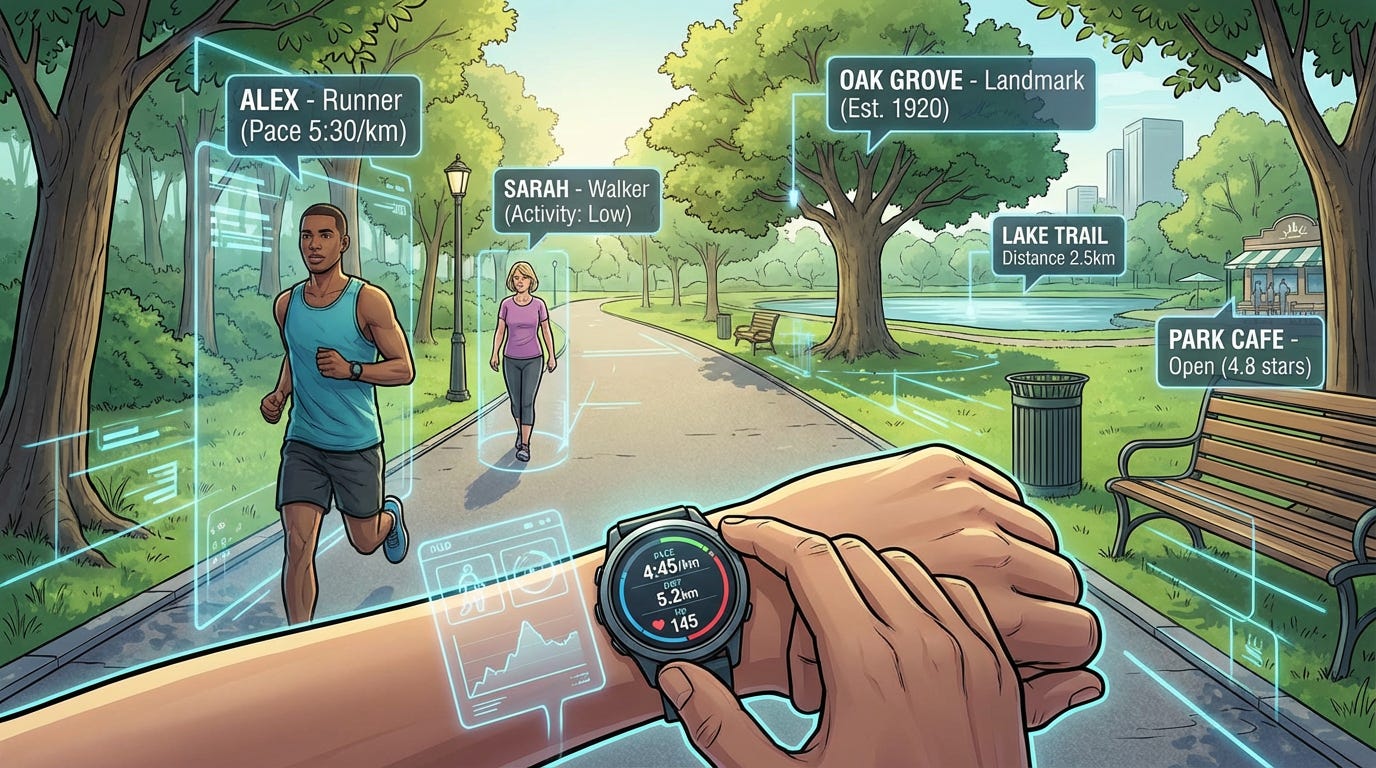
If there’s one transformational platform shift on the horizon that is rarely discussed, it is augmented reality (AR). In fact, the vibes around AR today remind me of the vibes around AI in 2016: it felt far away, most startups pitching were too far ahead of their time, investors questioned the practical use, and it became a buzzword that serious people avoided. Of course, five years later that all started to change for AI. Well, here we are again. Apple Vision Pro proved to be niche. Meta’s audio glasses have garnered attention, but the impending AR glasses still seem lackluster, based on early reviews. While we have a very long final mile to go here, there is no doubt in my mind that the ultimate technology interface will be an inch away from our retinas and become a layer of insight, knowledge, and engagement on the physical world. Even in just the last few weeks, rumors around the potential of Google’s new glasses made in collaboration with Warby Parker are getting people excited…
How will we know AR has truly arrived and that the consumer product gold rush has begun? There is a common belief among consumer product leaders that, when it comes to a truly innovative consumer product, you can tell if someone is using it from across the room. In other words, truly breakthrough consumer products ignite breakthrough consumer behaviors. For example, when you see people standing and holding a phone at the edge of the street, you can guess they’re using Uber. People looking at their phone and smiling are probably taking a selfie on Snapchat, while people dancing in front of their phones are probably using TikTok.
I’ve often wondered whether you can reverse-engineer this system. Can new ideas for consumer behaviors breed new consumer products? During my morning run the other day around Central Park, I imagined a world where people said “hi” to strangers and were accustomed to being recognized and approached by people they didn’t know directly. I wondered, in a world where everyone wore AR glasses tightly coupled with a trusted social graph that illuminated an aura of information around anyone you were connected with, would it suddenly become interesting, if not polite, to say hello to friends-of-friends? If I’m excited to meet a fellow New Yorker on a random train in Tokyo, why wouldn’t I get a similar sensation from bumping into my friend’s old roommate whom I never met? Will new sensations of connection help restore the growing sense of loneliness in this world? I ultimately believe that the greatest consumer technologies take us back to the way things once were, an era we long for, but with more scale and efficiency. Truth is, we long to be known. I am interested in new technologies that will make the world feel a bit smaller for all of us.
Ideas, Missives & Mentions
Finally, here’s a set of ideas and worthwhile mentions (and stuff I want to keep out of web-scraper reach) intended for those I work with (free for founders in my portfolio, and colleagues…ping me!) and a smaller group of subscribers. We’ll cover a few data points that caught my eye and have stayed on my mind as an investor, technologist, and product leader - as well as a preview of 10 predictions/outlooks for 2026 that are top of mind as a builder and investor. Subscriptions go toward organizations I support including COOP Careers and the Museum of Modern Art. Thanks again for following along, and to those who have reached out with ideas and feedback.
