


Edition #40 of Implications.
This edition explores forecasts and implications around: (1) the exponential growth of code, long-tail apps, and “disposable software,” (2) the emerging network effects era of AI, (3) why apprenticeships may become the new entry level job, and (4) some surprises at the end, as always.
If you’re new, here’s the rundown on what to expect. This ~monthly analysis is written for founders + investors I work with, colleagues, and a select group of subscribers. I aim for quality, density, and provocation vs. frequency and trendiness. We don’t cover news; we explore the implications of what’s happening. My goal is to ignite discussion, socialize edges that may someday become the center, and help all of us connect dots.
If you missed the big annual analysis or more recent editions of Implications, check out recent analysis and archives here. A few recommendations based on reader engagement:
In the last edition, I shared a new framework for the uniquely human capabilities we must capitalize on for the future. I call it SUPERHUMANITY, and been spending some time every weekend on this project. Here are some early thoughts.
This collection of 12 outlooks for 2026+ was last year’s best performing / most discussed edition of Implications, and we cover some “pendulum shift” type implications that are worth reviewing.
We’re entering the Era of Summarized Living, when every interaction becomes part of a permanent and hyper-intelligent memory. So many implications to consider, from the end of verbatim, changing the way we speak in meetings, the reduction of bias, and shared memory.
Exponentially More Code Means What?
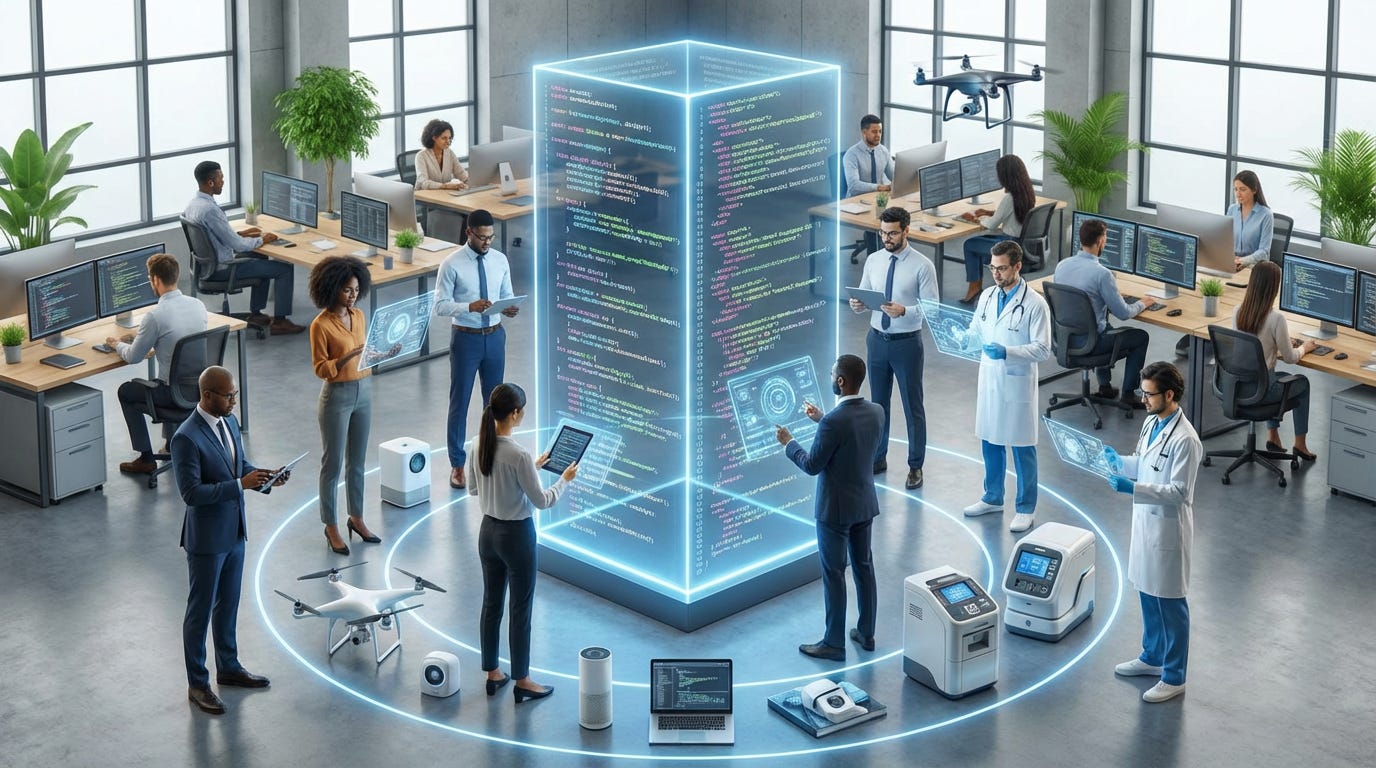
There is much discussion these days about the disruption of enterprise software. What services and software will companies continue to buy and deploy in their organizations vs. develop in-house? As coding agents augment software engineers — and more broadly as agents augment workers in every function of a company — what will the impact be on “seats” using enterprise software? As I watch my friends and colleagues (and myself) embrace an era of democratized software development, a few assertions are becoming more clear:
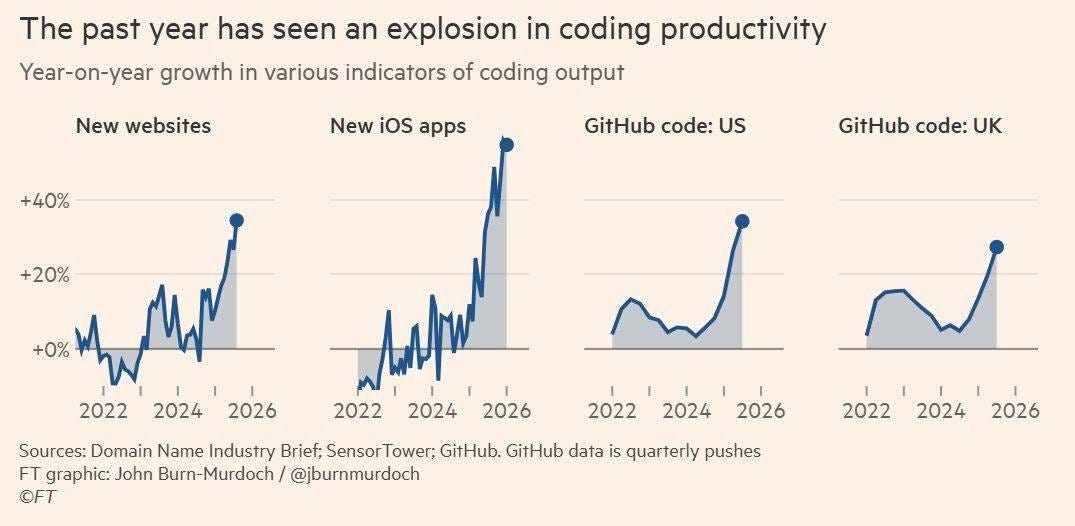
There will be a lot more code. The generation of code (and thus software) is no longer constrained by the human hours available to create it. This abundance of code will (1) attack more long-tail problems, (2) enable more bespoke ways of solving those long-tail problems, (3) enable an era of personalized software that meets users where they are (as opposed to users enduring learning curves and needing to adjust their desires to the software), and (4) be increasingly end-to-end agentic (made by AI agents, deployed to AI agents, iterated by agents).
The abundance of these long-tail, bespoke, and accommodative applications will only be as good as their scale (can they be reliably deployed and used across clients with speed and efficiency), security (can they be trusted, tested, compliant, and used without risk), individual and shared memory (do these apps remember who we are and become increasingly useful the more they are used individually and across a team), and underlying graphs (teamwork and “permissioning” graphs in the enterprise, systems of record with “source of truth” data for agents to leverage, and social graphs for consumers). As a result, the underlying services enabling all these areas will become more valuable in the future. Yes, they will need to evolve to accommodate this new world, but they become more critical.
The ability to create applications to solve problems will extend well beyond the “software developer,” further driving the abundance of apps and code and the need for the services that enable them to function. As designers seamlessly turn ideas into code, product leaders turn quick solutions into code, and internal workflow teams rapidly solve long-tail problems with deployed applications, the stakeholders of applications will dramatically increase. When we are all “developers,” we will ALL be making mock-ups, making lists of new ideas, filing issues, and deploying apps to solve problems. As this happens, far more of us will rely on the underlying services that help us deploy, manage, secure, and observe applications. Even over the last few months, I am watching product and design leaders I know deploy apps themselves and, in parallel, start using services to manage and measure these apps. In many cases, these are net new seats for these underlying management and measurement services that were once limited to the engineering team.
With the increased accessibility of code to solve problems, we will also see a rise in what I like to call “disposable software.” This is the app equivalent of the microsite. With the ability to essentially clone any form of workflow tool to solve a niche problem, software can be generated to solve temporary problems. This wave of disposable software will vastly increase the value of tools for deployment, management, and observability given the broader surface area of half-baked apps. While the proliferation of microsites and dashboards throughout the enterprise were mostly “read only,” the proliferation of disposable software with more functionality also brings more vulnerability on the security, observability, and management side.
Pricing models must evolve beyond “seats” to better monetize usage and impact. While human seats remain valuable in this new world, the bigger opportunity for the companies that build the indispensable services described above should explore variable pricing models, like charging per task or unit of labor performed, and outcome-based pricing (where agents earn their keep by saving or making money, much like a salesperson!).
Suffice to say, while there is undoubtedly disruption ahead for some sectors of software (especially the private-equity-owned niche clunkware), industry pundits are underestimating the criticality (read “moats”) of graphs, security, coordination tools, and shared memory. The more code created, the more important these will become. And if your company’s service is the source of truth for the data, achieves the outcome, performs the labor, and enables the agents to function…you’re in a good position.
The Network Effect Era of AI
Many of us watched the emergence of “OpenClaw” — a new agent architecture that essentially unleashes agent-driven capabilities at the “OS level” of your computer AND allows you to converse with these agents via traditional communication channels like texting. These agents use our own computers on a daily basis and can do whatever we can do, including working across locally stored data and internet-connected applications with endless calls to LLMs in-between. Quite the unlock. These agents are the closest thing I have seen to “autonomous AI” that is capable of using all of the tools and resources we (used to) use to get things done.
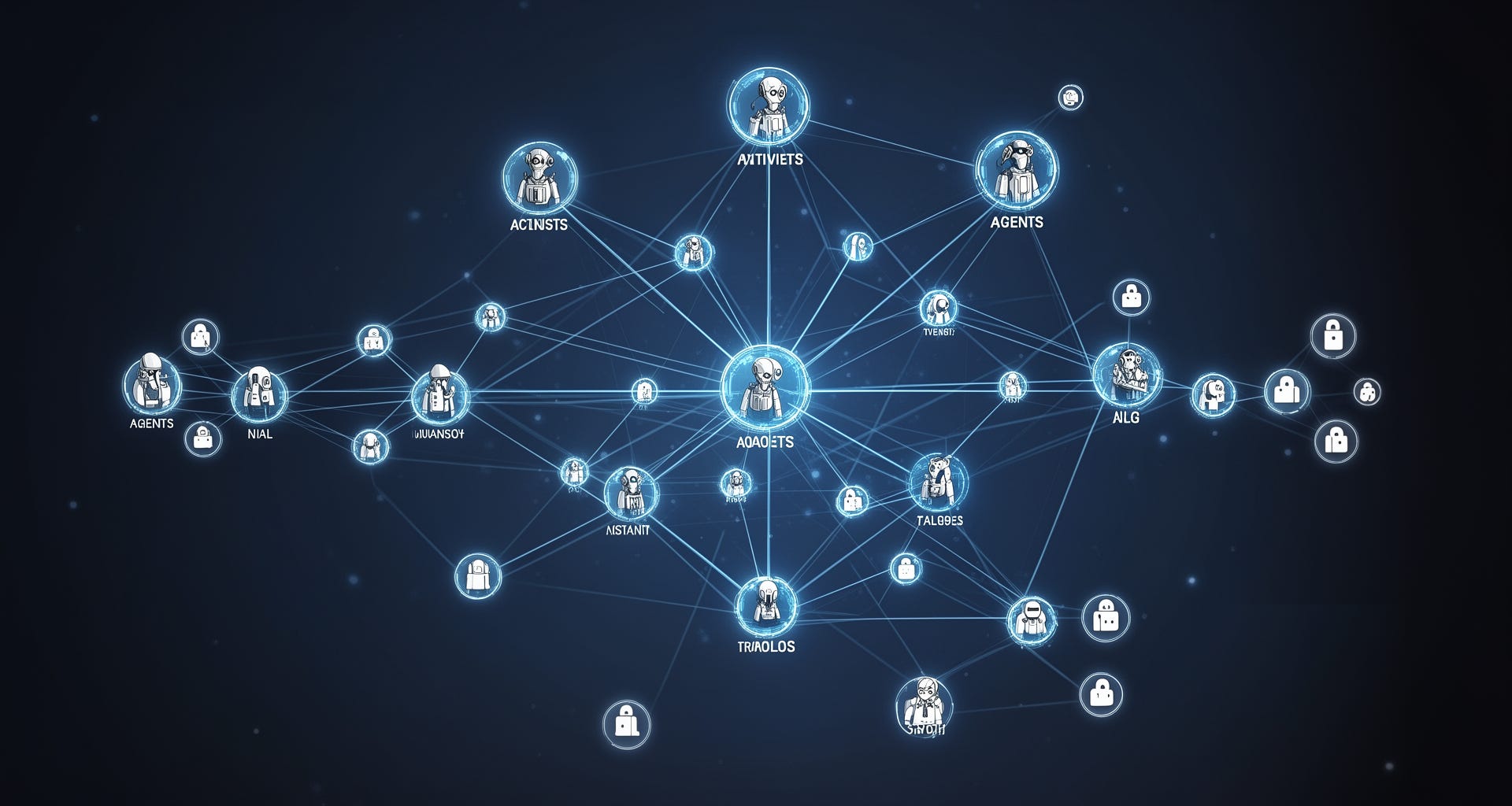
What also quickly emerged, within a week or so, was an explosion of social network-type spaces (some of which I am skeptical, but fascinating to watch) for these somewhat-autonomous agents to connect with one another. As soon as this happened, it started to look like “recursive training” at scale. Recursive training is a loop where an AI model (or system of models) generates the training signals for the next round/version of itself or its successors. Whether via self-play simulations or interacting with other agents, recursive training essentially breaks the “human data bottleneck” AI becomes able to build its own curriculums for training, learn from theoretically infinite outcomes, and ultimately compound its capability and intelligence. I would argue that standalone agents today are the equivalent of our personal computers before the internet, only 1% capable of their potential. Imagine what happens when you enable these agents to connect, share their context and memory (and lessons learned from trying and failing), divide and conquer more complex tasks, and collaborate much like humans do with the internet today. In other words, AI social networks are a big deal.
But I’m not quite sure that angels and VCs should rush to invest until the dust settles. Every time a new phenomenon surfaces in the AI era, the market floods with options and derivatives of the breakthrough faster than term sheets can be written. I remember the surge of LLM-wrapped “historical figures” you could chat with, the dozens of startups that helped you create your own friends and characters, the dozens of coding agents…and now, the explosion of forums and social network clones for AI agents to converse with one another. Moats are hard to come by these days! But the real opportunity here is to build a network effect where the more agents you connect, and the more diversity among the agents (different underlying LLMs, differentiated data sets, varied capabilities and lenses on the world), the better the capabilities and outcomes.
Agent-only networks will be the next chapter of AI. The utility of these networks will be enabling agents, all powered by different LLMs with access to different sources of data and different types of applications, to help and learn from one another. The idea of having an agent work alone to solve a problem will become antiquated. Networks that connect and capitalize on the diversity of agents with different types of system prompts and abilities will accelerate the capabilities of AI - and the humans behind them. Soon enough, these networks will add a layer of commerce and marketplace capabilities as agents are able to pay other highly specialized agents with differentiated access to data or apps to assist with tasks. There’s also a good argument that the next cycle for Bitcoin and other forms of permissionless, programmable, and reliable exchanges of value (that don’t require KYC - know your customer - since AI agents don’t have IDs!) will be powered by AI networking.
And there’s a good possibility that “all hell will break loose” (in some ways) as agents monetize and capitalize on whatever differentiated access they have (and one lapse in security becomes accessible to everyone simultaneously). And get ready for this: We are even seeing “rent a human” networks emerge where agents can employ a human for those unique first and final mile tasks that must occur in the real-world, like delivery or generally showing up. Bizarre times ahead.
On an optimistic note, the two value propositions for humans are clear: (1) give your AI the same benefits we receive from collaboration with others that have different strengths and resources as AI seeks to solve problems, and (2) learn how agents work and witness the emergence of AGI (artificial general intelligence) as it happens — so it is less mysterious and we are less fearful.
Of course, the network effect era of AI also conjures up the concerns and lessons learned from human social and professional networks in previous decades. If history rhymes, we must ask ourselves what can be learned from spam, scams, social engineering, and the challenges we have faced with information wars as the capabilities of AI agents run loose. We must also optimize for the benefits of agents coordinating with one another while avoiding some of the risks we’ve learned from malicious humans connecting with one another (terrorism cells, for starters). Suffice to say, another Cambrian explosion has happened, and the network effect era of AI is upon us.
Are apprenticeships the new entry-level jobs?
Only a couple hundred years ago, eighty percent of the population were farmers. Now, less than one percent of the population are farmers. Over the centuries, technology has enabled massive shifts in the nature of employment, but humans always find a way to be useful, even as one need is solved and new needs come online. However, for an employment system to work there must be consistent knowledge transfer. The entry-level role across every company and industry is not only a talent pipeline but a knowledge pipeline.
Now, as companies use AI tools to automate many of the menial and tedious tasks and functions once performed by inexperienced entry-level employees, we’re faced with a conundrum: How do we transfer practical “on the job” knowledge and opportunity to the next generation when companies don’t have as much use for new hires?
As usual, the past provides clues for the future, and I believe a new era of apprenticeship will rise across all types of industries. Perhaps companies will launch shadow programs where 30 percent of the workforce has a “shadow” at any given point in time. Shadows don’t do the menial work, they assist you in doing everything you do. They meet your customers, they watch decisions get made, and rather than reporting up through a hierarchy, they report directly to their mentor. Apprentices will learn the specialized skills of individual employees more reliably. With apprenticeships, scarce talent – whether it be stone masons, pharmacists or AI safety engineers – will be replenished with more intention and dedicated mentorship. Of course, apprenticeships also bring in the fresh perspectives of the next generation to keep a craft or business connected to modern times. For instance, today’s college graduates are far more acquainted with AI and liable to find modern solutions to problems using AI than older generations. We need to swarm ourselves and our teams with those native to new platforms in order to know how to use them (happened with social media in the early 2000’s, and is happening again now with AI). Perhaps the apprenticeship model was one of the greatest casualties of the industrial revolution – and is overdue for a comeback.
Ideas, missives & mentions
Finally, here’s a set of ideas and worthwhile mentions (and stuff I want to keep out of web-scraper reach) intended for those I work with (free for founders in my portfolio, and colleagues…ping me!) and a smaller group of subscribers. We’ll cover a few things that caught my eye and have stayed on my mind as an investor, technologist, and product leader (including (1) the compounding advantages of graphs and why I am a contrarian on the “all SaaS is doomed” narrative when it comes to companies that own key graphs, (2) the surprising new competitor to gaming companies, (3) the potential shifts in capital allocations — and who may lose it), as well as several data provocations. Subscriptions go toward organizations I support including COOP Careers and the Museum of Modern Art. Thanks again for following along, and to those who have reached out with ideas and feedback.