


Edition #47 of Implications.
This edition explores forecasts and implications around: (1) product realizations for the new era of “sixth sense” consumer AI products, (2) your emerging “trusted network of agents,” (3) the elimination of “lazy margin” - the profit companies (and governments) made from our apathy, and (4) some surprises at the end, as always...
If you’re new, here’s the rundown on what to expect. This ~monthly analysis is written for founders + investors I work with, colleagues, and ~40,000 subscribers. I aim for quality, density, and provocation vs. frequency and trendiness. We don’t cover news; we explore the implications of what’s happening. My goal is to ignite discussion, socialize edges that may someday become the center, and help all of us connect dots.
Check out recent analysis and IMPLICATIONS editions here (each is exhaustingly crafted, often times at 30,000 feet). A few recommendations:
The trend of so-called “forward-deployed engineers” will evolve into an elite centralized software and intelligence development team inside every company. Will the world’s best software be the software ONLY you have?
Reflecting on my own founding experiences as a product leader, and what I’ve learned from founders I’ve worked with, five principles stand out as things you must genuinely love doing to build great products.
You can’t buy history. The time invested in something is directly correlated to how we perceive value. As we crave things with roots, the time required for roots to grow becomes ever more precious.
Product Realizations for The Sixth Sense
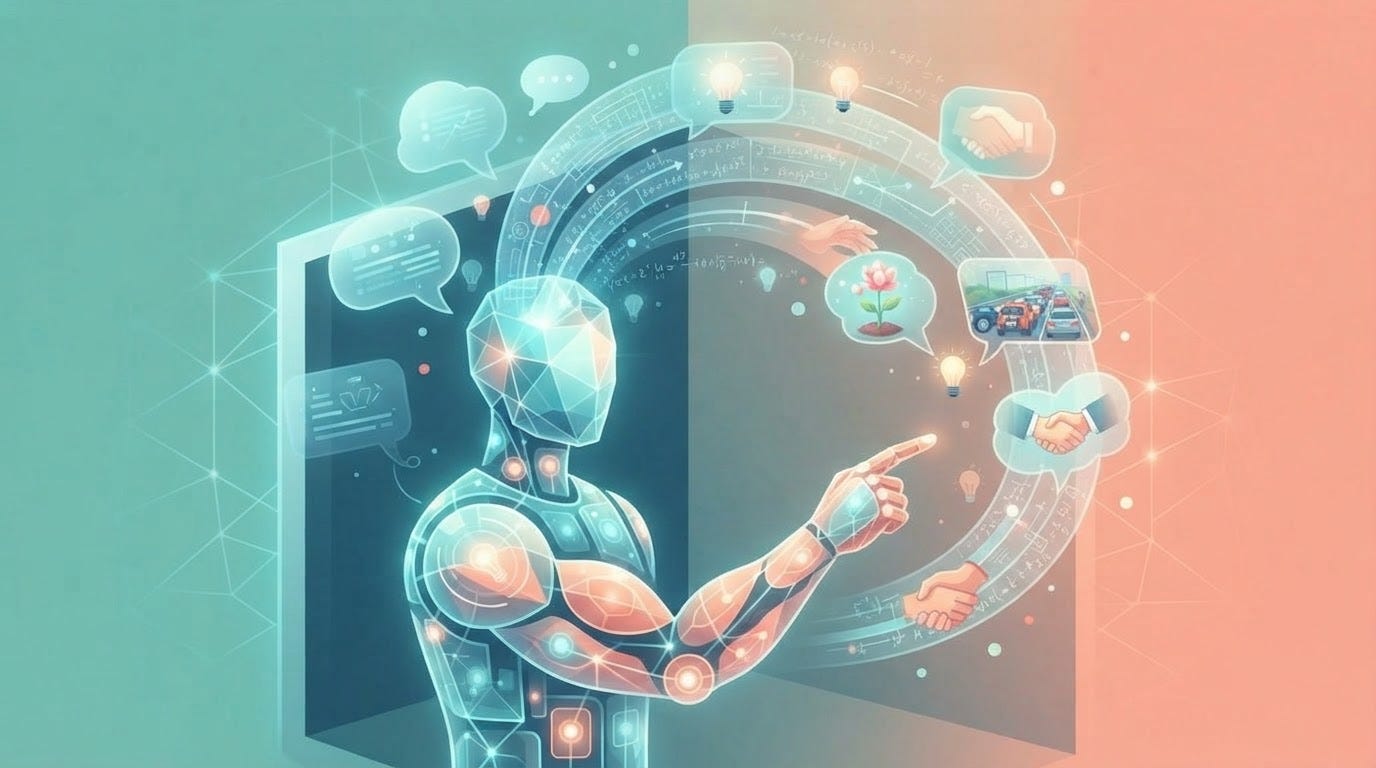
We’re only getting glimpses now, but a new sixth sense is emerging from AI that feels like something between foresight and premonition. Your “agent,” with full context of your life and models fine-tuned by the masses, will help you avoid pitfalls in how you spend your time and help you prioritize as a parent, leader, and friend. It will remind you to restock critical ingredients in your kitchen before you need them a week later. It will connect the dots around which friends will be in Italy before you board the flight to your vacation, and will only suggest the friends you actually want to see. It’ll suggest ways you can painlessly reduce your spending. It will solve problems in ways you had never imagined, and will begin making suggestions for problems you didn’t know you had. And it will do all of this with a high signal-to-noise ratio — and without annoying you.
2026 is proving to be the year when consumer AI is finally figuring itself out. What are we realizing as this all unfolds?
We will trade some privacy for the benefits of communal intelligence. This new era of intelligence is tapped from the collective. Much like Waze leverages our constant location as we drive and freely shares our speed and traffic report data to enrich the experience of all drivers, the next gen of consumer agents will require a similar trade. Communal intelligence is a form of sixth sense akin to a hive mind, and the most powerful consumer product will convince us to share more in to achieve a new form of intuition (or, perhaps a super intelligent instinct) that cannot be replicated with traditional LLMs and ordinary training data. The privacy we are willing to trade is directly proportional to the trust we have in the product.
“Explorers vs. Guardians” is the new “Visionaries vs. Pragmatists. In previous eras, early adopting cohorts of customers known as “Visionaries” were those more willing and forgiving of a product’s shortcomings. Product teams worked tirelessly to improve their onboarding and polish their features to the point where later cohorts of customers, known as “Pragmatists,” could come in and find their way. Today, the early adopters are the “Explorers,” a cohort of customers willing to share their data and “trust by default,” despite the occasional misstep, as they explore the unknown. And the later cohorts of customers are the “Guardians,” who value their privacy as a precious asset and don’t want their data indexed. Trust is the bridge for Guardians to become Explorers.
Agent personality, proficiency, and personalization are the new UX, and will become as consequential as the graphical interface. As agents emerge across every aspect of our work and life with voice and chat interfaces, they will stand out through a new set of UX principles. These modern product practices will be optimized to gain maximum context (syncs to our data) via trust, stimulate our imagination to start engaging, and surprise and delight us with performance and premonition.
The ultimate opportunity is to build and leverage the “intentions graph.” As we go about our daily lives, we have countless ideas — from “I like that sweater he’s wearing” and “cool trailer, remind me when that movie comes out” to “I should call my parents more often” and “I’d love to visit that hotel someday.” Today, most of these thoughts are ephemeral and get lost alongside the opportunity to act upon them. But consumer agents will soon capture these thoughts as they happen and develop a new “intentions graph” that is the holy grail of commerce. Crafting agents that co-exist with our lives and capture intentions is the opportunity.
New users of a consumer product are still (at least initially) lazy, vain, and selfish in the first-mile experience and expect a quick return on their time and the data access they provide. ROI (return on the investment we make in a new product) no longer applies just to time spent, it also applies to data shared.
Contextual selective memory is a moat. The technology that enables contextual selective memory is not simple and must work across platforms as a core principle (after all, the stuff you do and buy happens across many websites, identities, and devices in your life). To scale, you need an efficient architecture and a logic engine that discerns what should be remembered (and why), and what should be forgotten. Our everyday lives are filled with countless events that are meant to be forgotten or are purely circumstantial. But some of the things we do (and the many complexities of when, why and how) are meant to be remembered, and this memory compounded over time is the ultimate moat for consumer AI.
Trust is a legit new vector of innovation, and is very different than privacy. Trust is about judgment, understanding an agent’s reasoning, and being able to audit and inspect the agent’s thinking and actions at any time. Much as Coinbase succeeded by being the most secure player in a sea of risky crypto startups, the consumer agentic products that invest in trust while providing a magical level of hospitality and personalization will win.
Loyalty will come from preferred and earned access. As more consumer agents like Instinct, Muse, Town, Fo, and others emerge, they will increasingly differentiate themselves through the preferred access they provide, and the access users earn via loyalty. The preferred “favored agent” access will come in the form of agents with faster access to services without navigating their websites (“headless” access), those with verified human owners, and those that belong to the “discount clubs” that big brands will launch for agents that cooperate with their business models. Loyalty will also be developed through tactics like points programs (the more you buy via your agent, the more discounts or access you get) akin to airline programs. New marketplaces (and business models) will emerge that help agents achieve access. And the products we use will require our creativity to become further personalized and unlock new ways to make us feel special.
Agents must transcend notifications. Back in 2017, I wrote a post lamenting the fact that mobile notifications had become the modern “tragedy of the commons,” as this critical channel of communications became abused by apps to the point where notifications became ineffective. One of the most obvious and least discussed advantages of consumer agents living in our messaging threads is that texting is a priority communications stream with notifications that are seldom turned off. The agents that win will not only have access to all of our context but will have an unobstructed way to communicate with us. This is the best argument I have heard for a dedicated device paired with an agent. Otherwise, it needs to live in your texts.
As intelligence becomes ubiquitous, people want scarce things that differentiates them. New marketplaces and product principles will emerge to scale “special.” Consumer products of all kinds are, to some extent, about identity. Whether it is the clothes we wear, the apps we use, or the devices we carry – they succeed not just through their utility but also through their story and how they make us feel about ourselves. As everyone gains access to super-intelligence, each of us will seek products that give us an edge or yield some form of access or personal compounded superpower that makes us feel special and differentiated. As soon as the initial phase of exploiting old pre-AI systems (for reservations, for tickets, for anything “first come first serve,” etc) subsides, agentic products will need to strike exclusive deals with suppliers to access scarcity on behalf of their users.
I’ll Have My Agent Call Your Agent

The key question among consumer agents right now is differentiation and loyalty. As we have discussed before in Implications, the coming network effect among agents will ultimately support retention and “communal capabilities” that make these products sticky. We got our first glimpse of this capability over the last few weeks, as Instinct rolled out the ability to grow your own “trusted network” of agents being used by your friends and family. Some fun examples from early users surfaced by Noah Shinn, the founder of Instinct, included scheduling meetings with trusted people, coordinating dinner across a group of friends, or setting up recurring tennis lessons between a coach and a student. But this is just a start, and network effects should take us even further!
Serendipity as a service: As our agents know our location, they’ll notify us of mutual contacts nearby when we land in a new city, or walk into a restaurant. Eventually, this serendipity will feel more like synchronicity as our agents proactively bring us together with likeminded people and opportunities.
Suggested introductions: Agents that know our business interests can coordinate with others agents to suggest mutually beneficial introductions. Perhaps the same thing happens for those in the data scene…AI matchmakers will be incredibly disruptive for the whole dating space.
Proactive triage: When calendars change, or our agents determine that our priorities should be different based on our personal goals, our agents can work with others’ agents that we trust to proactively shift things around.
I’ve always believed that time is our greatest asset and “your calendar reflects the truth of your values and priorities.” In this light, perhaps agents can help us live more as we intend rather than at the whims of anxiety, logistics, and happenstance? It is also striking that agents working with other agents can help fortify relationships and provide everyone a superpower that was once reserved for a small number of very wealthy people with world-class assistants. This reminds me of the early days of Uber, when everyone was able to feel the sensation of having a personal driver waiting for them outside a restaurant.
RIP Lazy Margin & Friction by Design
The other night I booked a flight to London, and then my consumer agent texted me saying that there was a flight available one hour later on the same airline that was 40% cheaper. I replied “it must be a different fare class or the old business class seats.” The agent replied, “I don’t think that’s right. It looks like a fare-bucket thing on that specific flight rather than new vs old cabin.” I asked it to change the flight and got a significant refund (and learned, I should no longer be allowed to book tickets myself!). Consumer agents are swiftly eliminating the long-tail of “lazy margin” - that is, the way companies profit from busy customers who don’t take the time to properly diligence a purchase, claim refunds and reimbursements they’re due or cancel unused phone lines or search for elusive discount codes. With the ability of agents to accomplish tasks 24/7 on our behalf, the potential ROI of a minute of our time is going up. Instead of spending an hour scouring Amazon to find a better price for household goods, you can just have your agent do it. You probably wouldn’t tolerate a long, frustrating phone tree to get a negligible refund or file a complaint against a parking garage that ripped you off, but if you can put an agent with virtually infinite time on the task, why not?
There are many things we simply don’t do because “it just ain’t worth the time.” But all of this is changing with the growing capabilities of consumer agents. As these agents gain widespread adoption, the era of “friction by design” — government and business processes designed with the assumption that people won’t put up with the costs and inconvenience to do something — will end. As more and more of us use agents to tackle life’s hassles, the implications are significant and numerous:
Physical barriers to access scarce resources. Much like how Hermes requires those who seek their most coveted handbags to request an elusive in-person appointment, we can expect new analog processes to emerge that reward those willing to sacrifice their time and convenience to achieve a particular good or service. Scarcity has always been a cultural flex, but those experiences or goods that cannot be cheated or hacked by agents will achieve a special status.
Proof of human. There are numerous startups, including one founded by the co-founder of OpenAI, that are in the business of validating human beings and serving as a “vouch” for one’s status as an actual human being in the course of various workflows. Perhaps a new variety of “engagement games” will emerge that require human engagement and skill to achieve a discount?
Iterative policies and a new era of AI-driven promotion. In response to the dissipation of “lazy margin,” perhaps companies will make up the gap by using AI for more dynamic pricing and smart (read: discriminative) promotions? What if companies start using AI to offer discount codes that are only accessible to “favored agents” of certain customers? What if the promotions themselves adjust to our consumer behavior (the faster you click on something or the way that you scroll the page influences the discount)? Will some discounts be preserved only for humans? No doubt, agents will transform both sides of the equation.
No human left behind. Will another form of inequality emerge between consumers who are armed with agents and those who are not? Expect a growing gap of capabilities. Those outfitted with these agents will enjoy the lowest possible prices and a supernatural ability to surf algorithms for opportunity and convenience, while others will pay full price. As the world adjusts, I hope you make the most of today’s agentic arbitrage.
Ideas, Missives & Mentions
Finally, here’s a set of ideas and worthwhile mentions (and stuff I want to keep out of web-scraper reach) intended for those I work with (free for founders in my portfolio, and colleagues…ping me!) and a smaller group of subscribers. We’ll cover a few things that caught my eye and have stayed on my mind as an investor, technologist, and product leader (including breakthroughs for attention management, routers as decision centers (what if this becomes the ultimate power layer?), ). Subscriptions go toward organizations I support including COOP Careers and the Museum of Modern Art. Thanks again for following along, and to those who have reached out with ideas and feedback.
