


Edition #46 of Implications.
This edition explores forecasts and implications around:
(1) the industry-leading software becoming tailor-made software
(2) the emergence of “favored agent” status
(3) five things you MUST love as a product leader
And some surprises at the end, as always...
If you’re new, here’s the rundown on what to expect. This ~monthly analysis is written for founders + investors I work with, colleagues, and a select group of subscribers. I aim for quality, density, and provocation vs. frequency and trendiness. We don’t cover news; we explore the implications of what’s happening. My goal is to ignite discussion, socialize edges that may someday become the center, and help all of us connect dots.
Check out recent analysis and IMPLICATIONS editions here (each is exhaustingly crafted, often times at 30,000 feet). A few recommendations:
I suspect the “ROI on tokens” will become a metric for humans; what can YOU achieve within a given allocation of compute? The era of efficient AI is here.
What do our pets think of us? How might cross-species communication will quickly become a geopolitical advantage? Are We Ready to Hear What Animals Have to Say?
Our malleable memory is a feature, not a bug. What are the implications of REMEMBERING EVERYTHING!?
Let’s dive into Edition #46:
The World’s Best Software Is Software ONLY You Have
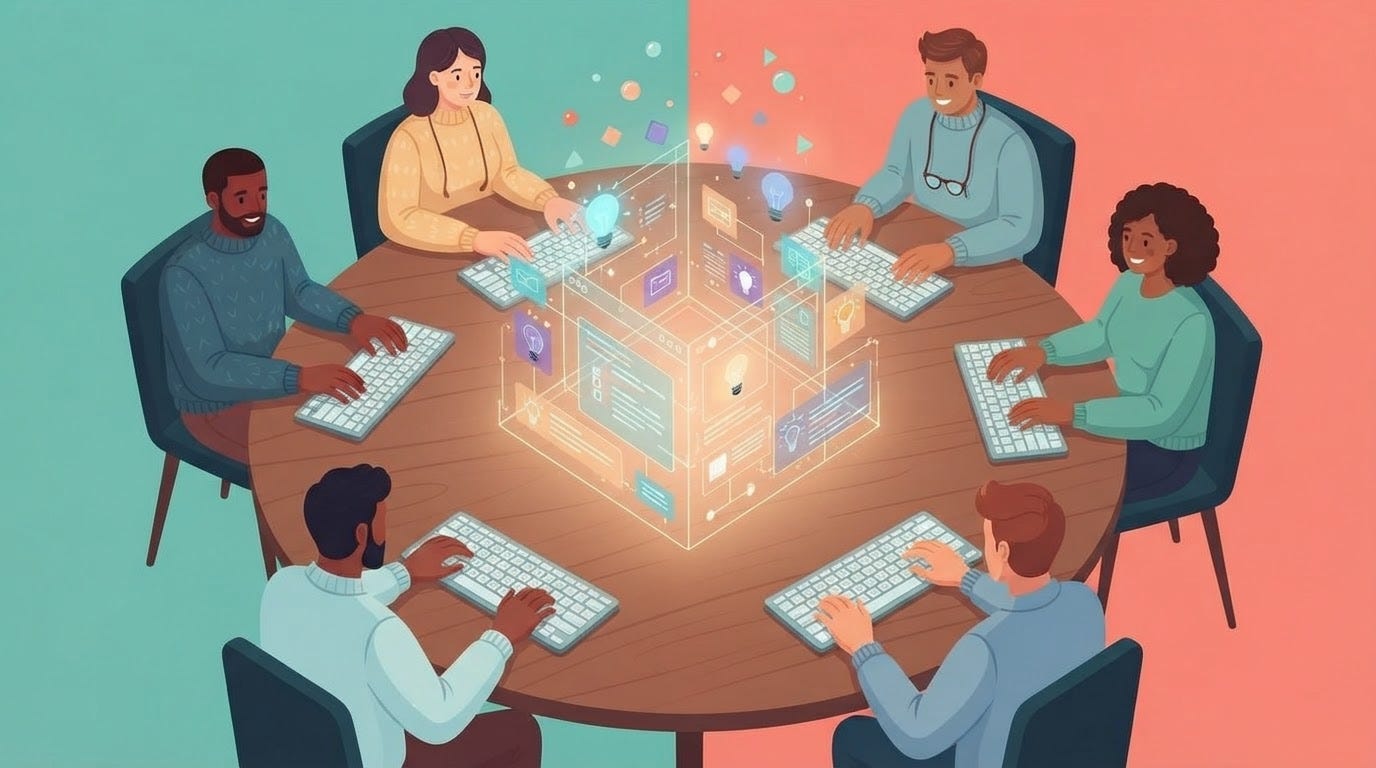
We’re shifting from an era in which everyone competed using the same set of generalized world-class software to a new era in which we will compete by creating software unique to us and our needs.
This is a profound shift. Until now, companies have always adjusted to the software provided to them. As a result, companies have looked and operated quite alike. For instance, since most big companies operate on Workday, Adobe, Microsoft and the like, it is especially hard to differentiate based on how you operate. For those companies with bold ideas to refactor workflows or collapse functions together, the obstacle was often the generalized software…designed to be good enough for everyone’s needs at the expense of your unique needs.
Fast forward, we’re now in a world of tailor-made software. The era started with vibe-coding simple apps, evolved with the ubiquity of MCPs for agents (the conduits that help the functionality of software extend beyond the applications themselves), and is maturing to the point where small engineering teams within companies can build custom software. These new variants of project management tools and operating systems for the enterprise are native to the culture of the company they serve. They are far more customizable and integrated than any enterprise software we’ve ever seen. Like a home-cooked meal tasting better, they are more enjoyable to use. As we look ahead, what are some likely implications?
Company Operating Systems: The trend of so-called “forward-deployed engineers” will evolve into an elite centralized software and intelligence development team inside every company. This small, talent-dense group of designers, product leaders, and engineers will design and iterate a proprietary company operating system (CompanyOS) that connects work across functions, centrally manages agent development and deployment, and gradually evolves the company into a “cognico,” as discussed in previous editions of IMPLICATIONS. Cognicos are a futuristic vision for how a company will operate with inference at the center and AI-driven functions performed by customized software as nodes.
Enterprise software becomes enterprise graphs and intelligence management tools. As this potential future plays out, what happens to the likes of Workday, Adobe, Microsoft, Atlassian (where I am on the board), and others that power functions of today’s enterprise? Those who own a vital graph for the organization, and those who manage the intelligence of the organization, will thrive. Those who don’t are in trouble. For example, Atlassian builds and hosts a company’s “teamwork graph,” based on every user’s interactions, connections among colleagues and with projects, as well as the logic for how work gets done. This graph, paired with AI, drastically improves search results, answers to queries, and agentic actions while also reducing the cost of tokens used for AI. While the applications themselves remain valuable (and some might argue become more useful), the value of graphs and intelligence will only grow. The interfaces may change (or become custom), but the value prevails and grows.
Centralized AI vs. Specialized AI: It is becoming increasingly clear that smaller, more specialized AI models may be the most cost-efficient solution for specific functions of a company. The need to call Claude and OpenAI’s frontier models by default is dwindling. What does this mean for the mega models? Perhaps they will start offering industry-specific models of their own, fully tuned with training data from specific industries. Will we get frontier legal models, physics models, and health models from OpenAI and Anthropic? We could have an Anthropic model that law firms use to build their own software or Anthropic will service our legal needs directly. Or perhaps the best legal models will be open source models that law firms use to make their own proprietary operating software? We shall see.
Some of this sounds wildly disruptive and full of conjecture, but I think it is likely. We’ll shift from today’s world of centralized models with generalized capabilities to a future of countless decentralized models with specialized capabilities. And we’ll shift from generalized software for an industry to software tailor-made by teams for their own proprietary workflows. We’ll look back in a few years and realize that the world’s best software in each industry is the software that only one player in the industry has (and made for themselves!).
Favored Agents

There is a new cohort of very exciting products, like Instinct (getting a ton of fanfare right now on social from early beta users!), Grok Bot, Littlebird (incredible vision for work agents), and Hermes from Nous Research among others that bring agentic capabilities to ordinary consumers and workers within a company. Some of this magic was achievable (or hackable!?) earlier this year with open source efforts like OpenClaw, but now we’re all getting closer to an era of the ever-capable agent in your pocket that remembers your preferences, can accomplish all sorts of tasks on your behalf, and increasingly predicts what you want before you ask for it.
I have been going deep with a few of these, and am pretty mesmerized. Via a simple text, I can optimize my subscriptions on Amazon, prepare for a trip to Europe, and query all sorts of data and my calendar. It is especially powerful when you feel remembered and considered by these agents. With Instinct, each time the agent needs access to a website (my credit card statement, Amazon, Airbnb, etc), it asks for my login via an encrypted link and then saves it for next time. But many of the agents I am testing keep running into situations where they hit a bot check. While I am able to help the agent overcome any two-factor authentication issues, they still aren’t able to complete CAPTCHAs and other bot checks for obvious reasons (they are bots!). Which leads me to an idea: What if the moat for these agent companies is to achieve “favored agent” status with direct preferred access to services like Uber, Airbnb, Amazon, Amex, and the long-tail of companies that otherwise guard against bots? What if the agent-service relationship becomes a new marketplace for underlying service providers (like Uber, Amazon, etc) to grant access (or perhaps even provide faster and cheaper access than humans ordinarily get?) in exchange for becoming the preferred default vendor for a particular need? What if the ultimate business model for agent companies is to strike these “default provider” deals? Or perhaps buying this “favored agent” status is the ultimate cost for these agent companies?
My experimentation has led me to believe and learn so many things about the way consumer agents will help us in our everyday lives as consumers, parents, and builders. It has also made me believe that the first “favored” agents that get proprietary and preferred access to the banks and stores and other online processes that we use on a daily basis will have an incredible advantage. Right now, agents are trying to navigate websites made for humans and pass login constraints designed to block bots, but favored agents that pass some level of security authentication should be able to go direct to the data and the services of the companies that we interact with daily. And the companies that open their doors to legitimate agents will prosper from this massive new and action-oriented audience, often armed with credit cards!
Five things you must love as a builder…

Building something from nothing, at the mercy of customer happiness and team engagement, is a fascinating discipline. Reflecting on my own founding experiences as a product leader, and what I’ve learned from founders I’ve worked with, five principles stand out as things you must genuinely love doing to get the signals you need, build a winning team, and grow into the type of leader your product deserves.
You’ve got to love constructive feedback (to the point where you see it as gold) AND you must enjoy moments when your deep convictions are doubted. Because when everyone tells you you’re crazy, you’re either crazy or you’re really onto something. You must obsess over criticism of what isn’t working, but be wary of cynicism - and learn to gain confidence from doubt.
You must love vigorously debating with your team because debate means you’re exploring new territory where the answer isn’t obvious. Debate is the most efficient way to navigate the surface area of possibility. Debate exposes differing viewpoints and increases the odds of finding the best decision. Keep your team engaged when disagreeing and fight apathy ruthlessly.
You must love merchandising, in all its forms. Merchandising is more than just sales. It is endlessly creating and sharing the narrative of your company and your product with your team, investors, customers, and, when appropriate, the public. Whether you are hiring, retaining, converting, or improving the performance of your team, you are merchandising the what and why and how. It is the most important thing — and they don’t teach it in business school!
You must genuinely love building a team and culture as much as a product. After all, your product will look like your team. If your design team is weak, or the marketing folks aren’t talking to the product folks, it shows in your product. The potential of your product starts with your people, and the potential of a team compounds with their commitment and alignment. Build a culture that gets stronger from volatility. Thoughtfully construct your team. The REAL competitive advantage across any industry is a great team sticking together long enough to figure it out.
And, last but not least, you must love the time you spend with customers and the end users of your product. The best products don’t come from passion for a solution, they come from empathy for those suffering a problem. You need to love being shoulder-to-shoulder, identifying the pain, testing solutions, and feeling tightly aligned with your customers’ wants, needs, and insecurities.
Ideas, Missives & Mentions
Finally, here’s a set of ideas and worthwhile mentions (and stuff I want to keep out of web-scraper reach) intended for those I work with (free for founders in my portfolio, and colleagues…ping me!) and a smaller group of subscribers. We’ll cover a few things that caught my eye and have stayed on my mind as an investor, technologist, and product leader (including “focus, as a service,” my hot take on the holding companies gobbling up SaaS darlings, “to be or not to be a DAU, that is the question,” rare datasets, and AI safety layers. Subscriptions go toward organizations I support including COOP Careers and the Museum of Modern Art. Thanks again for following along, and to those who have reached out with ideas and feedback.
